


May cause joy: The full-spectrum health benefits of dance
When musician David Byrne, the founder of Reasons to be Cheerful, performed at the sold-out Dolby Theatre in Los Angeles last fall, the entire crowd was on its feet for almost the entire show. They danced enthusiastically for nearly two hours straight, feeling a kind of unfiltered joy that's rare to access in everyday life.
The experience was a reminder of a long-dormant love of dance. The following month brought a sign-up for "Groove Therapy" with local dance teacher Leah Lynn. The youngest in our group is 16, the oldest over 70. Every Saturday, the class plays out a verb each participant brings to class — release, gather, resist, invite — translating abstract intentions into motion. It sounds faintly ridiculous. It is also disarmingly effective. Within minutes, something shifts. Stress loosens. Then for the next hour, the group learns hip-hop shuffles and swings their hips to Kool & the Gang or Beyoncé. The class ends with the same feeling each time: exhausted and exhilarated.
The dance classes provoked such a profound shift in mood as well as in the body that it was worth finding out if there was more to it.
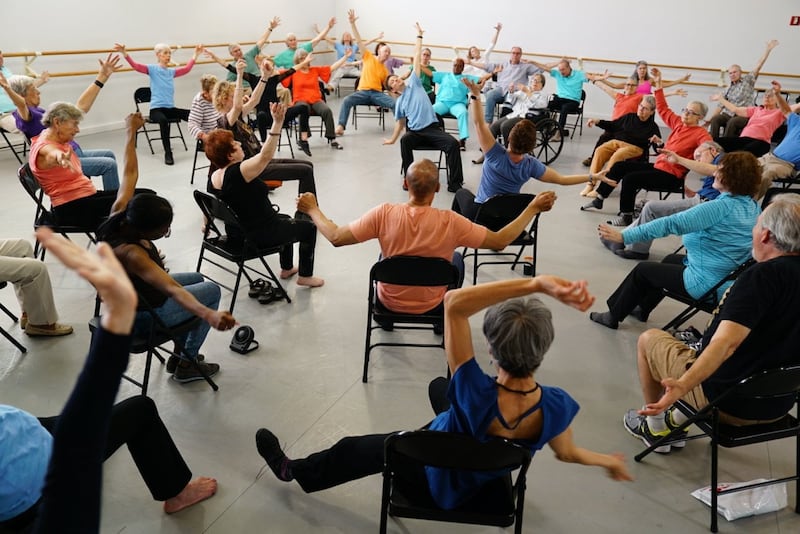
Eddie Marritz // Dance for PD
Modern research is now increasingly suggesting that dance is medicine, a deeply effective intervention for physical, cognitive, and emotional health. Behind the feel-good performance lies hard science. On a purely physical level, dance improves cardiovascular fitness, strength, and coordination. In a longitudinal study, seniors who took part in regular dance training fell less often and were described as "physically better off and mentally fitter" than those in the control group.
Though the body benefits are impressive, the neurological ones are what make scientists lean forward. Dancing activates a wide network: auditory pathways, visual and motor cortex, the amygdala, and, above all, the somatosensory cortex and networks that keep track of where your body is in space. Each change in rhythm or melody is processed in milliseconds and translated into new steps, adjustments, and expressions, a form of real-time "multitasking" that pushes the brain harder than many other sports.
Nobody understands this better than the dozen people who gather for David Leventhal's class at a dance studio in Brooklyn. Though it's cold outside, Leventhal is conjuring a beach. "Visualize what that warmth feels like," he says, brushing his hands over his arms as if applying sunscreen. "Can we take those waves in different directions, just like they do in the ocean?" Around him, a dozen bodies begin to ripple to the tune of the pianist in the room. Arms slice, float and curl through the air. For a moment, the bare white room is less clinic than coastline.

Eddie Marritz // Dance for PD
Leventhal, who danced for 13 years with the Mark Morris Dance Group, has spent the last quarter century leading a different kind of choreography: Dance for PD, a program for people living with Parkinson's disease.
What began in Brooklyn in 2001 now reaches more than 30 countries and roughly 500 communities. Across the room, people who arrived with their shoulders slightly caved inward now stand taller. They trace arcs through space, step through a tango phrase, and turn what might otherwise register as tremor into jazz hands.

Amber Star Merkens // Dance for PD
Participants in the program, which was created by the Mark Morris Dance Group and the Brooklyn Parkinson Group, routinely report better balance, more confidence walking, and a renewed sense of self. But just as often, they mention something less clinical and more essential: joy.
"I sometimes cannot walk, but I can dance," participant Cyndy Gilbertson said in the documentary Capturing Grace. "The music leads, in other words; it's not my brain telling me to take a step."
You don't need a severe diagnosis to benefit from dance. "Dance has been part of our human culture for millennia," Leventhal points out. "It's how we communicate, how we express emotion, how we find each other, how we build community." Across cultures, from Indigenous North American traditions to Māori and Pacific Islander practices, dance has also long been intertwined with healing.

Amber Star Merkens // Dance for PD
Over time, this seems to change the brain's structure. A German study that followed older adults in a dance program for more than a year reported increases in gray matter volume and synaptic density in regions important for memory and executive function, along with preserved cognitive performance over five years of follow-up. The researchers found that dancing appeared to build "cognitive reserve" and was "the best prevention" against age-related cognitive decline in their cohort, with dancers showing a statistically lower risk of dementia than nondancers.
Those findings dovetail with a widely cited observational study: People who danced more than once a week had a 76% lower risk of developing dementia than those who danced less often, an association reported as stronger than that seen with many popular "brain games."
"It's a full-spectrum activity," Leventhal explains. "It engages the body, cognition, emotion, and social connection — all supported by music."

Amber Star Merkens // Dance for PD
The real power, he argues, lies in the overlap. "The benefits come from the synergy among those domains."

Amber Star Merkens // Dance for PD
That synergy matters especially for Parkinson's, which affects motor control, cognition, emotional expression and social engagement. Many people withdraw from public life as symptoms progress. "The beauty of this art form," Leventhal says, "is that it's a full-spectrum intervention for a full-spectrum condition."
In a large meta-analysis of 55 randomized controlled trials in Parkinson's disease, dance emerged as the most effective of nine exercise interventions for improving balance in that analysis, outperforming even advanced rehabilitation technologies. Styles like tango, waltz and foxtrot have been shown to improve gait speed and reduce falls.
While there is no cure for Parkinson's, some early research suggests that dance can slow down the progression significantly for some people. "It's early evidence," Leventhal says carefully. "But exercise may be one of the only disease-modifying approaches we have."
"Our auditory cortex synchronizes with the motor cortex," Leventhal explains — a mechanism particularly relevant in Parkinson's, where internal rhythm is disrupted by dopamine loss. External rhythm can step in as a kind of substitute metronome. "It creates a roadmap," Leventhal says. "Someone described it as a red carpet rolling out in front of them." For people who struggle to initiate movement, that cue can be transformative, enhancing neuroplasticity — the brain's ability to form new connections.
"Novelty is huge," Leventhal says. "New patterns, new music, new movement." But novelty alone isn't enough. "When something is also meaningful to you — when it connects emotionally, that's when the brain is really activated."

Eddie Marritz // Dance for PD
Another, more practical advantage: People keep coming back. Some participants have been dancing with Leventhal for over 16 years. People are welcome at all stages of Parkinson's. Some arrive in a wheelchair, others have recently been diagnosed. "If people can get to class, they stay," Leventhal says.
That kind of adherence is rare in exercise programs, especially for chronic conditions. The reason, again, circles back to neuroscience. Motivation is tied to dopamine, the very neurotransmitter depleted in Parkinson's. Apathy is common. Getting on a treadmill can feel like scaling a wall. Dance, by contrast, lowers the barrier.
"The combination of music, social interaction, and movement is highly motivating," Leventhal says. "Some people come to see their friends and stay for the movement. Some come for the music."

Amber Star Merkens // Dance for PD
And one more factor he considers crucial: "We don't treat people as patients," he says. "You're a dancer. You're learning a craft."

Eddie Marritz // Dance for PD
When we move rhythmically, stress hormones like adrenaline and cortisol decline while the brain's own reward chemicals — endorphins, dopamine, serotonin — surge, a set of "pleasure cycles" documented by researchers at Aarhus University who studied how music and synchronized movement generate feelings of social bonding and euphoria.
For people living with depression, anxiety or trauma, dance offers something more subtle: a way back into the body. According to a 2024 review, dance can be more effective in alleviating depressive symptoms than any other form of exercise. Where distress constricts expression, dance expands it.
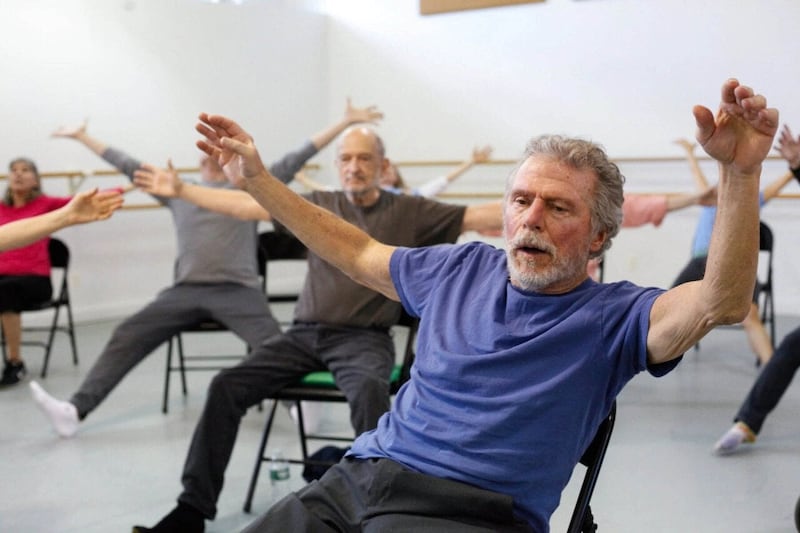
Amber Star Merkens // Dance for PD
Plenty of workouts happen with headphones and in isolation. Dance, by contrast, almost always involves connecting with others. Social neuroscientists have shown that moving in synchrony with others increases liking, trust, and willingness to help. "We entrain to each other," Leventhal says. "And that raises empathy, connection."
For people with Parkinson's, the stakes are higher than mood or fitness. The disease is the fastest-growing neurodegenerative condition in the world. By the time it is diagnosed, estimates suggest that roughly 70% of dopamine-producing cells are already lost.
Which makes timing critical. "We want people to start earlier," Leventhal says — not just to maintain function, but to build skills and resilience before symptoms advance.
At the end of Leventhal's class, the participants play an imaginary volleyball game, batting an invisible ball through the air. "We won, you won, we all won!" Leventhal cheers, and all arms lift in victory.
This story was produced by Reasons to be Cheerful and reviewed and distributed by Stacker.